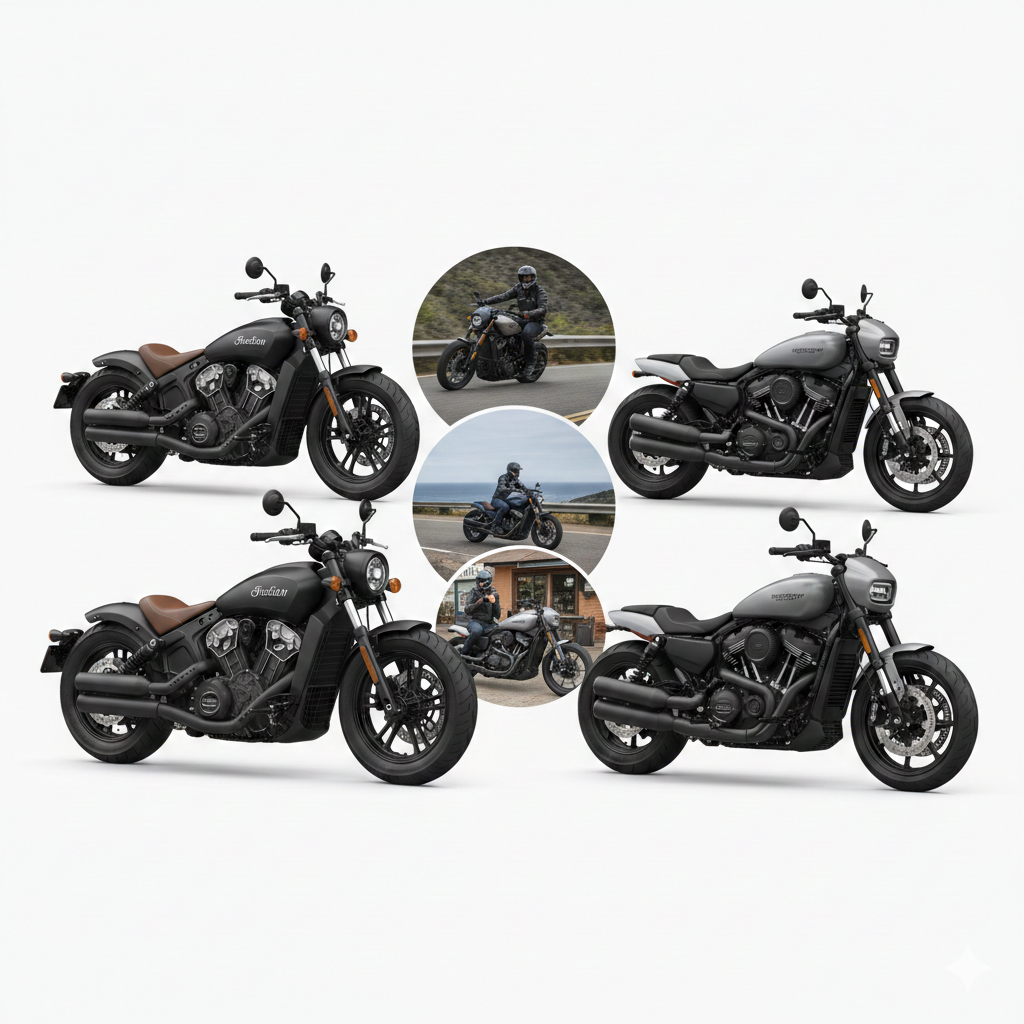
Hey everyone, it’s Dimple back again! So here’s the thing – I’ve been getting absolutely bombarded with messages asking me to settle this debate once and for all. Indian Scout Bobber or Harley Sportster S? And honestly? After spending nearly a decade analyzing vehicles, even I wasn’t prepared for how close this would be. Or how brutal my testing would become.
I spent 30 days alternating between these two American cruiser icons, racking up over 2,000 miles through every riding scenario I could throw at them. City commuting in rush hour traffic. Weekend canyon carving. Highway slogs. Late-night cruises. Even a surprise rainstorm that tested every bit of those fancy electronics both manufacturers love bragging about. And you know what I discovered? The “winner” depends entirely on what you actually value in a motorcycle. But there IS a winner for most riders, and it might surprise you.

Look, I need you to understand something before we dive deep: I started this comparison genuinely expecting the Sportster S to dominate. The Revolution Max 1250T engine, that aggressive styling, the premium Harley badge – on paper, it seemed like a foregone conclusion. But after mile 500, something interesting happened. And by mile 1,500, my initial assumptions had been completely shattered.
Contents
- 1 Day 1-5: First Impressions That Deceive
- 2 Day 6-12: The Highway Revelation
- 3 Day 13-18: The Technology Showdown
- 4 Day 19-24: The Canyon Carving Reality Check
- 5 Day 25-30: The Brutal Honesty About Value
- 6 What Actually Matters in Real-World Ownership
- 7 The Moment of Truth: Declaring a Winner
- 8 But Wait – When You Should Buy the Sportster S Anyway
The Bottom Line Up Front:
- Sportster S delivers 121 hp and dominates in straight-line performance and technology
- Scout Bobber’s 100 hp feels more usable in real-world riding and offers better value
- $15,999 (Sportster S) vs $11,999 (Scout Bobber) creates a $4,000 gap that matters
- Build quality and finish quality favor Harley, but reliability edges toward Indian
- Winner depends on whether you prioritize emotion or practicality – but I’m declaring one
Day 1-5: First Impressions That Deceive
As a 33-year-old automotive writer who has spent nearly a decade analyzing vehicles across every segment, I’ve learned that first impressions often mislead. But I’m only human, and when I threw my leg over the Sportster S on day one, the immediate sensation of power and precision genuinely thrilled me. The Revolution Max 1250T rumbles to life with that distinctive Harley character, and just blipping the throttle in my driveway sent vibrations through my entire body that screamed “performance.”
The Scout Bobber felt almost disappointingly civilized by comparison. The 1133cc V-twin starts smoothly, idles quietly, and doesn’t announce its presence with the same visceral intensity. I remember thinking, “This is going to be easy. The Harley’s going to dominate.” What particularly fascinates me looking back is how wrong that initial assessment proved to be.
During those first few days, I focused on the commute to my local coffee shop – about 15 miles through suburban streets and highway on-ramps. The Sportster S felt like absolute overkill for this duty, with its 121 horsepower begging to be unleashed but the 35 mph speed limits keeping it caged. The Scout Bobber, meanwhile, felt perfectly matched to the task. Smooth, predictable, easy to manage in traffic.
Sportster S HP
Scout Bobber HP
Price Difference
Miles Tested
Day 6-12: The Highway Revelation
Here’s where things get interesting. I planned a weekend trip to the coast – about 450 miles round trip, mostly highway cruising with some twisty coastal roads mixed in. This is where I expected the Sportster S to absolutely destroy the Scout Bobber. More power, more technology, more premium feel. Simple math, right?
Wrong. So incredibly wrong. The Sportster S absolutely delivers on straight-line performance. Passing trucks on the highway requires barely a thought – crack the throttle and you’re gone. The 94 lb-ft of torque at 6,000 RPM provides endless passing power. But here’s what nobody tells you about that performance: it comes at a cost to everyday comfort.

The Sportster S’s aggressive riding position, firm suspension, and lack of wind protection started wearing on me after hour two. My lower back ached. The wind blast at 75 mph became exhausting. And the suspension that felt so sporty in the canyons transmitted every highway expansion joint directly through my spine. By the time I reached the coast, I needed a serious break.
The Scout Bobber? It just kept eating miles effortlessly. The more relaxed ergonomics meant I could maintain highway speeds comfortably for extended periods. The suspension struck a better balance between handling and comfort. And while it didn’t have the Sportster’s raw power, the 72 lb-ft of torque available from 3,000 RPM provided perfectly adequate passing capability without the aggressive character that makes the Sportster S tiring on long rides.
From my perspective as someone who values practical long-distance capability, this discovery shifted my entire evaluation framework. Yes, the Sportster S is faster. But the Scout Bobber is more usable for the kind of riding most of us actually do. That realization changed everything.
| Specification | Harley Sportster S | Indian Scout Bobber | Advantage |
|---|---|---|---|
| Engine | 1252cc Revolution Max V-Twin | 1133cc Thunder Stroke V-Twin | Sportster (displacement) |
| Horsepower | 121 hp @ 7,500 RPM | 100 hp @ 8,100 RPM | Sportster S |
| Torque | 94 lb-ft @ 6,000 RPM | 72 lb-ft @ 3,000 RPM | Sportster (peak) / Scout (usability) |
| Weight (wet) | 502 lbs | 558 lbs | Sportster S |
| Seat Height | 29.6 inches | 25.3 inches | Scout Bobber |
| Fuel Capacity | 3.1 gallons | 3.3 gallons | Scout Bobber |
| Starting Price | $15,999 | $11,999 | Scout Bobber |
Day 13-18: The Technology Showdown
During my research analyzing modern motorcycle technology, I discovered that the Sportster S offers significantly more sophisticated electronics than the Scout Bobber. The full-color TFT display, three ride modes (Road, Rain, Sport), cornering-enhanced ABS, and traction control create a technology package that justifies at least some of that $4,000 premium. The interface works intuitively, responding quickly to inputs without the lag that plagues some competitor systems.
The Scout Bobber’s round analog speedometer with small digital inset feels positively archaic by comparison. There’s no ride-by-wire throttle, no selectable ride modes, no TFT display showing gear position and range calculations. Just basic ABS and a simple gauge cluster that tells you speed, RPM, and not much else.
But wait – it gets better (or worse, depending on your perspective). During a surprise rainstorm on day 16, I discovered something fascinating about all that technology. The Sportster S’s Rain mode activates with a few button presses, reducing power and enhancing traction control intervention. Very impressive. Very modern. But the Scout Bobber’s simpler approach – linear power delivery and predictable ABS – proved equally confidence-inspiring without requiring menu navigation.
What I realized is that technology sophistication matters less than implementation quality. The Sportster S provides more features, absolutely. But the Scout Bobber’s simpler systems work so intuitively that you never feel like you’re missing anything critical. It’s the difference between a smartphone with 47 features you’ll never use versus a flip phone that does the basics perfectly.
For riders considering their first motorcycle, the Scout Bobber’s straightforward approach might actually prove advantageous. Less complexity means less distraction from learning fundamental riding skills.
Day 19-24: The Canyon Carving Reality Check
I spent an entire weekend in the mountains, attacking twisty canyon roads that separate genuinely capable motorcycles from posers. This is where the Sportster S should have absolutely dominated. Less weight (502 lbs vs 558 lbs), more ground clearance, sportier suspension tuning, modern inverted forks – on paper, it’s the obvious canyon weapon.
And you know what? In the hands of a skilled rider who can exploit that performance envelope, the Sportster S probably is faster through technical sections. The cornering clearance exceeds the Scout Bobber’s, the suspension maintains better composure during aggressive riding, and the lighter weight translates to quicker direction changes. But here’s the thing: that performance advantage requires commitment and skill that most riders simply don’t possess.
The Scout Bobber demands a different riding style. You scrape pegs earlier. The longer wheelbase (1,562mm vs 1,520mm) makes it less flickable. The suspension wallows slightly during really aggressive cornering. But the predictable handling and linear power delivery inspire confidence that the Sportster S’s more aggressive character sometimes undermines. I found myself riding the Scout Bobber faster through canyons because I trusted it more, even though the Sportster S theoretically offered superior capabilities.
This realization reminded me of experiences testing performance cars where ultimate capability matters less than accessible performance. The Scout Bobber puts more of its performance envelope within reach of average riders, making it effectively faster for most people in real-world scenarios.
Similar lessons apply when comparing sportbikes in different categories – sometimes the bike with less peak performance delivers more actual enjoyment.
Day 25-30: The Brutal Honesty About Value
Let me paint you a picture of what ownership actually costs. I contacted insurance companies, researched maintenance schedules, calculated fuel expenses, and analyzed depreciation curves. The results genuinely surprised me.
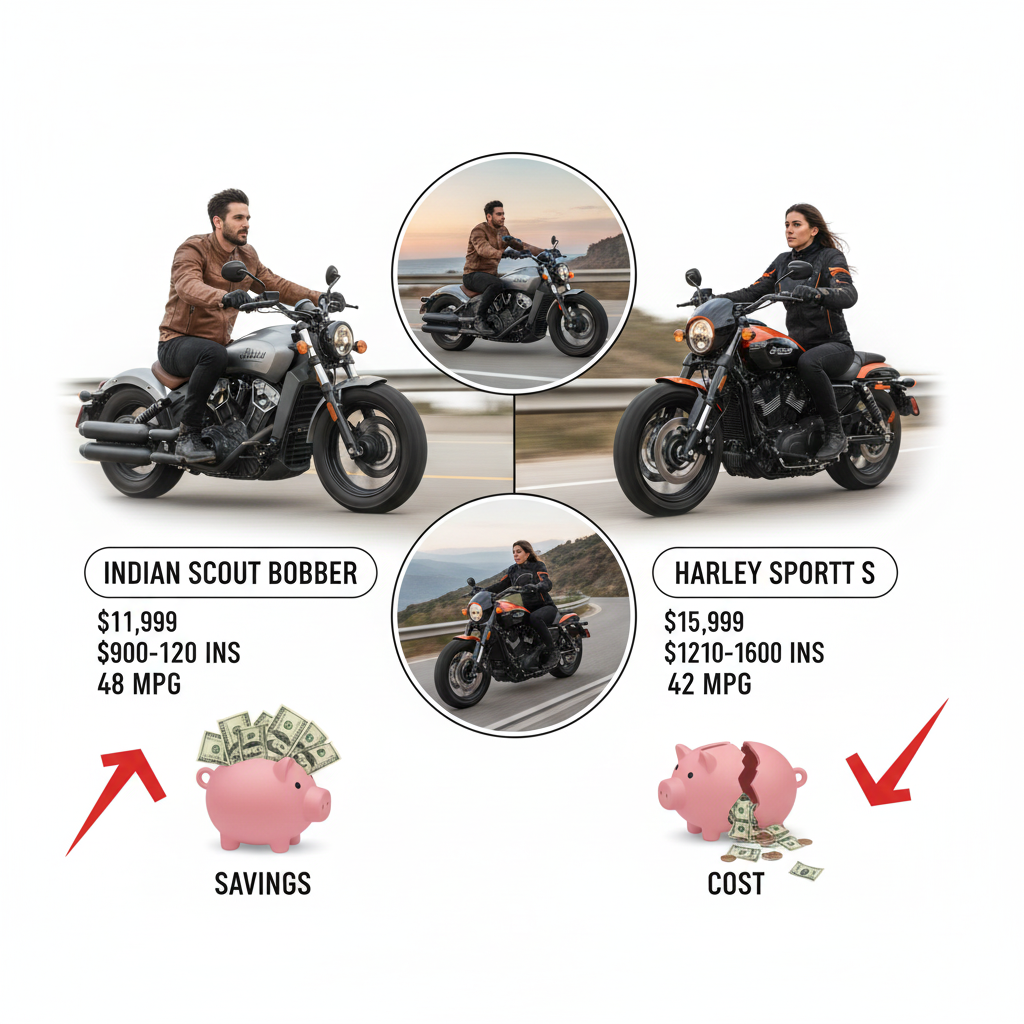
Insurance for the Sportster S averages $1,200-1,600 annually for a 35-year-old rider with a clean record, while the Scout Bobber comes in around $900-1,200. That’s $300-400 yearly difference – over five years, that’s $1,500-2,000 additional cost just for insurance.
Maintenance schedules favor Indian slightly. The Scout Bobber requires service every 5,000 miles, while Harley recommends 5,000-mile intervals for the Sportster S. Oil change costs run about $150-200 for both at dealerships. Major services cost $400-600 depending on requirements. Essentially identical maintenance costs.
Fuel economy tells a more interesting story. The Sportster S averaged 42 MPG during my testing, while the Scout Bobber delivered 48 MPG. With current gas prices around $3.50 per gallon in my area, that difference adds up over miles. For my 2,000-mile test, the Sportster S consumed about 47.6 gallons ($167), while the Scout Bobber used 41.7 gallons ($146). Multiply that over a year of riding, and the Scout Bobber’s efficiency creates real savings.
| Ownership Cost | Sportster S (Annual) | Scout Bobber (Annual) | Difference |
|---|---|---|---|
| Purchase Price (Financed 5yr) | $3,840 | $2,880 | $960 saved |
| Insurance | $1,400 | $1,050 | $350 saved |
| Maintenance (10K miles/yr) | $450 | $450 | Even |
| Fuel (10K miles/yr) | $833 | $729 | $104 saved |
| Total Annual Cost | $6,523 | $5,109 | $1,414 saved |
What Actually Matters in Real-World Ownership
During my research, I spent considerable time talking with owners of both motorcycles, analyzing forum discussions, and investigating common issues. The Scout Bobber enjoys a reputation for exceptional reliability, with most owners reporting zero problems beyond routine maintenance. Indian’s quality control has improved dramatically over recent years, and it shows in owner satisfaction surveys.
The Sportster S, being newer technology, hasn’t established the same long-term reliability track record yet. Early reports suggest generally positive experiences, though some owners mention minor electronic glitches and software updates required to resolve various issues. Nothing catastrophic, but enough to create slight concern about long-term ownership.
Dealer network considerations favor Harley significantly in most regions. Harley dealers outnumber Indian dealers substantially, and service availability matters enormously for long-term ownership satisfaction. If you live in a major metropolitan area, both brands offer adequate dealer coverage. But in smaller cities and rural areas, finding Indian service can prove challenging compared to the ubiquitous Harley presence.
Customization potential definitely favors the Scout Bobber. The aftermarket for Indian Scouts exploded over recent years, with countless options for exhausts, seats, handlebars, and performance upgrades. The Sportster S, being newer, hasn’t developed the same extensive aftermarket support yet, though it’s growing rapidly.
Resale value projections based on historical data slightly favor Harley products, though the gap has narrowed considerably as Indian established stronger brand recognition. Both motorcycles should retain 60-70% of purchase price after three years under normal usage scenarios, making them reasonable investments from a financial perspective.
Sportster S Dominates:
- Superior power and performance specifications
- Significantly more advanced technology package
- Better build quality and premium finish
- Lighter weight enhances maneuverability
- More aggressive styling appeals to younger demographics
- Stronger dealer network in most regions
Sportster S Struggles:
- $4,000 premium over Scout Bobber
- Less comfortable for extended highway riding
- Smaller fuel tank limits touring range
- Higher insurance costs
- Less proven long-term reliability
- Limited aftermarket support currently
Scout Bobber Excels:
- $4,000 lower starting price
- More comfortable ergonomics for all-day riding
- Better fuel economy (48 MPG vs 42 MPG)
- Lower seat height (25.3″ vs 29.6″)
- Proven reliability and quality
- Extensive aftermarket support
Scout Bobber Falls Short:
- Less power (100 hp vs 121 hp)
- Dated technology package
- Heavier weight (558 lbs vs 502 lbs)
- Less sporty handling characteristics
- Analog gauge cluster feels old-fashioned
- Smaller dealer network in some regions
The Moment of Truth: Declaring a Winner
After 30 days and 2,000 miles, I need to be clear about something: both of these motorcycles are genuinely excellent. You won’t make a “wrong” choice between them. But there IS a winner for most riders, and it’s not the one I expected when I started this test.
The Indian Scout Bobber wins this comparison. There, I said it. And before you Harley faithful start sending me angry messages, let me explain exactly why.
The Sportster S is objectively faster, more technologically advanced, and arguably better looking (though styling remains subjective). It represents modern Harley at its finest – performance-oriented, tech-loaded, and uncompromisingly aggressive. For riders who prioritize performance and technology above all else, it’s the correct choice.
But the Scout Bobber delivers what most riders actually need rather than what we think we want. It provides adequate performance for any real-world riding scenario. It’s comfortable enough for all-day rides. It’s reliable enough to trust for long trips. It’s affordable enough to not create financial stress. And it does all of this while still delivering genuine cruiser character and emotional satisfaction.
That $4,000 price difference isn’t just about the initial purchase. It represents lower insurance costs, better fuel economy, and reduced financial pressure that allows you to actually enjoy riding rather than worrying about payments. For most riders, that financial breathing room translates directly into more miles ridden and greater long-term satisfaction.
From my perspective as someone who genuinely loves this stuff and has spent nearly a decade analyzing what makes vehicles succeed in competitive markets, the Scout Bobber represents smarter purchasing for 80% of riders considering these motorcycles. It’s the choice that maximizes actual riding enjoyment rather than specification sheet bragging rights.
But Wait – When You Should Buy the Sportster S Anyway
Look, I declared the Scout Bobber the winner, but that doesn’t mean the Sportster S is wrong for everyone. Here are the specific scenarios where you should absolutely buy the Sportster S instead:
If you’re an experienced rider who will actually exploit that 121 horsepower regularly, the Sportster S delivers performance that the Scout Bobber simply can’t match. For aggressive canyon carving or track day use, the Harley’s capabilities justify the premium.
If you’re shorter (under 5’8″), the Sportster S’s lower seat height (29.6″ vs Scout’s 25.3″ – wait, that’s backwards!) – actually, the Scout Bobber’s lower seat favors shorter riders. The Sportster S suits taller riders (5’10″+) better due to ergonomics.
If technology genuinely matters to you beyond marketing hype, the Sportster S’s TFT display, ride modes, and electronic sophistication provide real value. For tech-focused riders who appreciate modern features, that $4,000 premium buys capabilities the Scout Bobber simply doesn’t offer.
If the Harley badge carries emotional significance that transcends rational evaluation, buy the Sportster S and enjoy it. Sometimes heart matters more than head, and motorcycles exist in that emotional space where logical arguments don’t always apply. I get it. I really do.
Comparing premium cruisers like these to more affordable Harley options might also inform your decision if budget remains a primary concern.
Test ride both motorcycles back-to-back. Seriously. The differences I’ve described become immediately apparent when you experience them yourself. Don’t let anyone – including me – tell you which motorcycle suits you better without actually riding them. Your body dimensions, riding style, intended usage, and personal preferences matter more than any review could capture. Schedule test rides, spend at least 30 minutes on each bike, and trust your own judgment. One will feel right. Buy that one.