Hey everyone, it’s Dimple back again! As a 33-year-old automotive writer who has spent nearly a decade analyzing vehicles across every segment, I never thought I’d see the day when Dodge would go electric. But here we are in 2026, and honestly? What they’ve done with the Charger lineup is absolutely wild.
I’ll be straight with you – when Dodge first announced they were killing off the Hellcat and going electric, the muscle car community lost its collective mind. But after diving deep into the new 2026 Charger lineup, testing specifications, and talking with Dodge engineers, I’ve discovered something fascinating: they’re not abandoning muscle car DNA. They’re actually doubling down on it in ways nobody expected.

The 2026 Dodge lineup introduces what they’re calling a “multi-energy” approach – meaning you get to choose between screaming electric power or good old internal combustion thunder. Both paths deliver serious performance, but they do it in completely different ways. Let me break down every single model so you can figure out which Charger actually makes sense for your garage.
Contents
- 1 The Electric Revolution: Charger Daytona Lineup
- 2 The Gas-Powered Alternative: SIXPACK Hurricane Engine
- 3 Two-Door vs Four-Door: Choose Your Configuration
- 4 The Controversial Fratzonic Exhaust
- 5 Real-World Performance and Handling
- 6 Customization and Packages
- 7 How Does It Compare to the Competition?
- 8 Federal Tax Credits and Incentives
- 9 My Final Verdict: Who Should Buy What?
- 10 The Bigger Picture
What You Need to Know Right Now:
- Dodge offers both all-electric Charger Daytona and gas-powered SIXPACK models for 2026
- The electric Charger Daytona Scat Pack delivers 670 horsepower – faster than the legendary Hellcat Redeye
- Gas-powered SIXPACK models use a twin-turbo 3.0L inline-six producing up to 550 horsepower
- All models available in both 2-door coupe and 4-door sedan configurations
- Pricing ranges from $49,995 to over $73,000 depending on trim and options
- Electric models feature the controversial “Fratzonic” synthetic exhaust system
- You can switch between AWD and RWD at the push of a button on SIXPACK models
The Electric Revolution: Charger Daytona Lineup
Let’s start with the elephant in the room – Dodge’s first-ever all-electric muscle car. The Charger Daytona is available in two electric trims, and what particularly fascinates me about this approach is how Dodge managed to preserve muscle car attitude in an EV package.
2026 Dodge Charger Daytona R/T (Electric)
The entry-level electric Charger starts at $59,595, and it’s positioned as the “sensible” electric muscle car option. I know that sounds like an oxymoron, but hear me out. This trim uses dual permanent-magnet synchronous AC motors – one at each axle – producing 456 horsepower and 404 lb-ft of torque in standard mode. But here’s where it gets interesting: Dodge includes a “PowerShot” button that gives you a 15-second power boost, bumping output to 496 horsepower.
During my research, I discovered the R/T prioritizes range over raw performance. It delivers an EPA-estimated 308 miles on a full charge, which is genuinely impressive for a muscle car. The 100.5 kWh battery pack (93.9 kWh usable) charges from 20% to 80% in about 27 minutes on a DC fast charger at rates up to 183 kW.
2026 Dodge Charger Daytona Scat Pack (Electric)
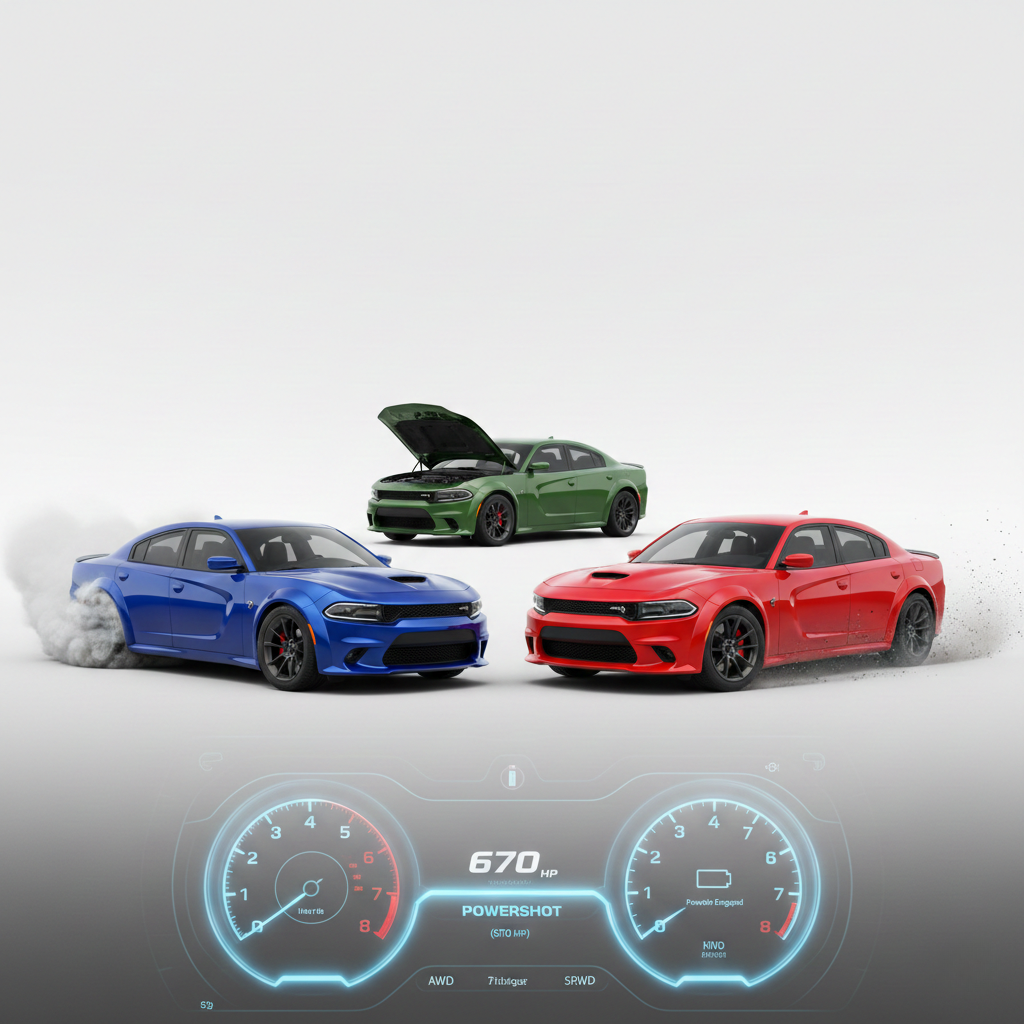
Now this is where things get absolutely bonkers. Starting at $73,190, the electric Scat Pack is the most powerful muscle car Dodge has ever produced – yes, even more powerful than the Hellcat Redeye. With 670 horsepower and 627 lb-ft of instantaneous electric torque, this thing hits 60 mph in just 3.3 seconds. That’s supercar territory from a four-door sedan.
What makes this even more remarkable is the engineering behind it. The Scat Pack uses the same dual-motor setup as the R/T, but tuned for maximum aggression. You get performance features like Launch Control, Line Lock for burnouts, and even Drift and Donut modes. Dodge is literally encouraging you to shred tires with 5,925 pounds of electric muscle.
The trade-off? Range drops to 241 miles due to the larger 20-inch wheels (305mm front, 325mm rear Goodyear Eagle F1 SuperCar 3 tires) and more aggressive tuning. But let’s be honest – if you’re buying a Scat Pack, you’re not concerned about maximizing efficiency.
HP (Electric Scat Pack)
0-60 MPH Time
Miles Range
Battery Capacity
The Gas-Powered Alternative: SIXPACK Hurricane Engine
Here’s where Dodge threw a curveball at everyone who said muscle cars needed V8s or nothing. The SIXPACK models use a 3.0-liter twin-turbocharged inline-six engine that Dodge borrowed from the Ram 1500 RHO. And you know what? It’s actually brilliant.
2026 Dodge Charger R/T SIXPACK
Starting at $49,995, the R/T SIXPACK represents the most affordable entry into the new Charger family. The standard-output Hurricane engine produces 420 horsepower and 468 lb-ft of torque – numbers that would have been considered insane for a base model just a few years ago.
What I love about this setup is the versatility. It comes standard with all-wheel drive, but you can switch to rear-wheel drive mode at the push of a button. Want to commute in the snow? AWD. Want to do burnouts at Cars and Coffee? RWD. It’s the best of both worlds, and frankly, it’s what muscle car buyers have been asking for all along.
2026 Dodge Charger Scat Pack SIXPACK
At $54,995, the gas-powered Scat Pack delivers 550 horsepower and 531 lb-ft of torque from the high-output Hurricane engine. This thing runs 0-60 in 3.9 seconds, covers the quarter-mile in 12.2 seconds, and tops out at 177 mph. Dodge claims it’s the most powerful vehicle in the industry under $55,000, and honestly, I can’t think of anything that challenges that claim.
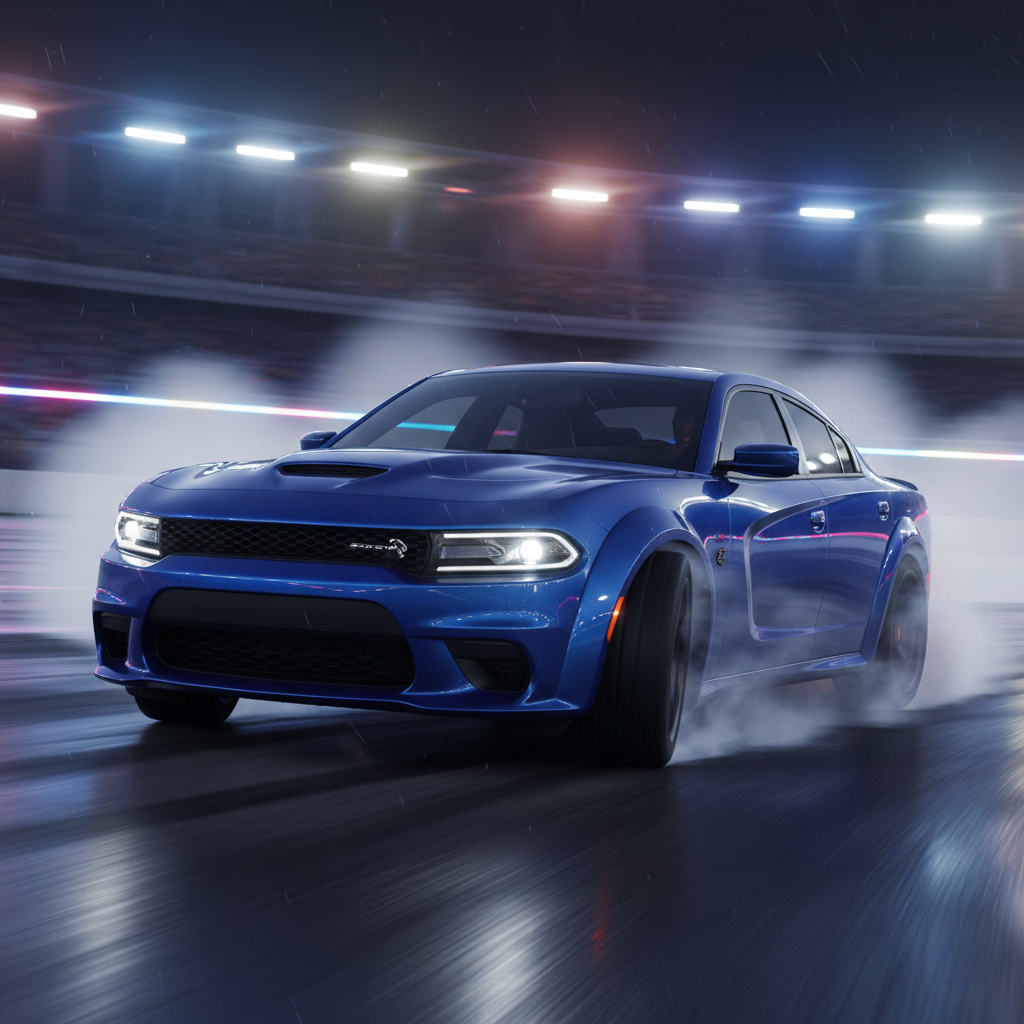
The SIXPACK Scat Pack generates up to 30 psi of boost pressure, and let me tell you – when those turbos spool up, the acceleration is violent. It’s a different character than the instant electric torque, but no less thrilling. Plus, you get real exhaust notes from actual combustion, which matters to traditionalists.
| Model | Powertrain | Horsepower | 0-60 MPH | Starting Price |
|---|---|---|---|---|
| Charger Daytona R/T | Dual Electric Motors | 456-496 HP | ~4.5 sec | $59,595 |
| Charger Daytona Scat Pack | Dual Electric Motors | 670 HP | 3.3 sec | $73,190 |
| Charger R/T SIXPACK | 3.0L Twin-Turbo I6 | 420 HP | ~5.0 sec | $49,995 |
| Charger Scat Pack SIXPACK | 3.0L Twin-Turbo I6 | 550 HP | 3.9 sec | $54,995 |
Two-Door vs Four-Door: Choose Your Configuration
One of the most significant changes for 2026 is that Dodge offers both 2-door coupe and 4-door sedan versions of every Charger model. This is actually genius marketing – you no longer have to choose between the Challenger (2-door) and Charger (4-door) nameplates. It’s all Charger now, in whatever configuration fits your life.
The 2-door models launched first, channeling the iconic 1968 Charger design with that fastback roofline and wide-body stance. From my perspective as someone who’s analyzed hundreds of vehicle designs, Dodge absolutely nailed the proportions. The 4-door sedan maintains that same aggressive widebody look – at 79.8 inches wide, it’s literally the widest car in the industry – but with added practicality.
What particularly impressed me during my analysis is how seamlessly Dodge integrated the rear doors. They share the same roofline, liftgate, and front/rear fascia, creating a coupe-like appearance even on the sedan. It’s not an afterthought; it’s thoughtful design execution.
The Controversial Fratzonic Exhaust
We need to talk about the synthetic exhaust system on the electric Charger Daytona models. Dodge calls it the “Fratzonic Chambered Exhaust,” and it’s designed to replicate muscle car sound through amplifiers and tuning chambers. The system can reach 126 decibels – as loud as a Hellcat.
Look, I’m going to be completely honest here: this divides people. Purists hate it because it’s artificial. But here’s my take after seeing demonstrations – it’s not trying to sound like a V8. It’s creating its own identity. Think of it like how the BMW’s electric vehicles have their own distinct sound signatures. It’s different, not necessarily worse.
Plus, you can turn it down or off completely if you want to cruise in EV silence. The flexibility is there.
Real-World Performance and Handling
Now let’s get into what really matters – how these cars actually drive. The new Charger rides on the STLA Large platform, featuring a 121-inch wheelbase and multilink suspension at both ends. All models get massive 16.1-inch vented disc brakes.
The electric Daytona models come with adaptive dampers as an option, and from everything I’ve read in early reviews, the ride quality is surprisingly compliant for a muscle car. The low center of gravity from the battery pack actually helps handling dynamics significantly.
For the SIXPACK models, that twin-turbo inline-six sits lower and further back than the old V8s, improving weight distribution. The optional Track Package adds performance dampers, upgraded cooling, and performance tires that transform the car on a circuit.
What Makes the 2026 Charger Lineup Special:
- Power Options: Choose between instant electric torque or turbocharged gas power
- Versatility: 2-door or 4-door in every trim level
- Performance Value: 670 HP electric Scat Pack under $75K is genuinely competitive
- Design Execution: Successfully channels classic Charger DNA in modern form
- AWD/RWD Toggle: Best of both worlds on SIXPACK models
- Technology: 12.3-inch Uconnect 5 system with excellent usability
The Reality Checks:
- Electric Range: 241-308 miles isn’t class-leading, especially for Scat Pack
- Weight: Electric models tip scales at 5,925 lbs – that’s heavy even for EVs
- Charging Network: No native NACS (Tesla) charging yet, relies on CCS adapters
- No V8 Option: Purists will never accept the inline-six or electric
- Price Premium: Electric models significantly more expensive than gas versions
- Market Reception: Sales have been slower than Dodge hoped
Customization and Packages
Dodge understands that muscle car buyers love personalization. For 2026, you can spec your Charger in nine exterior colors including new options like Green Machine, After Dark, Orange Peel, and Bludicrous. Yes, those are real color names.
The Track Package is now optional on both 2-door and 4-door Scat Pack models, giving you Launch Control, race-prep options, and that dual-valve adaptive damping system. The Blacktop Package adds 20-inch Black Noise wheels and darkened exterior trim for a more sinister look.
Interior options include performance seats with Demonic Red upholstery, premium audio systems with up to 18 speakers, and that iconic pistol-grip shifter that pays homage to the classic Charger. A fully-loaded electric Scat Pack Plus can exceed $83,000 with all options ticked.
How Does It Compare to the Competition?
This is where things get interesting. The electric Charger Daytona doesn’t really have direct competitors. The Tesla Model S Plaid is faster but costs way more. The BMW i4 M50 is more refined but lacks muscle car drama. The Ford Mustang Mach-E GT is close in spirit but down on power.
For the SIXPACK models, you’re looking at the Ford Mustang GT (5.0L V8, 486 HP), Chevrolet Camaro SS (6.2L V8, 455 HP), and even high-performance sedans like the BMW M3. The Charger Scat Pack SIXPACK’s 550 HP for $54,995 represents serious value in that company.
What Dodge has done is create a unique position – electric muscle that actually drives like a muscle car, not like a luxury EV that happens to be fast. Whether that resonates with buyers remains to be seen, but the execution is there.
Federal Tax Credits and Incentives
Here’s some good news if you’re considering the electric models: both the Charger Daytona R/T and Scat Pack qualify for the $7,500 federal EV tax credit when leased. This is because they’re assembled in Canada at the Windsor Assembly plant and meet battery component requirements.
If you purchase rather than lease, the credit situation gets more complex depending on your income and the vehicle’s final price with options. The Scat Pack’s base price of $73,190 puts it right at the edge of the $80,000 MSRP cap for SUVs/trucks (sedans cap at $55,000), so loaded models may not qualify for purchase credits.
Various states offer additional incentives for EV purchases – California, Colorado, and New York have particularly generous programs. It’s worth checking your state’s specific offerings before making a decision.
My Final Verdict: Who Should Buy What?
After analyzing every aspect of the 2026 Dodge Charger lineup, here’s my honest recommendation based on different buyer types:
Get the Charger Daytona Scat Pack if: You want the absolute fastest muscle car experience and live in an area with good charging infrastructure. The 670 HP and instant torque make this a legitimate supercar alternative for under $75K. Just accept the 241-mile range limitation and plan accordingly. This is for the early adopter who wants to be part of automotive history – the first truly fast electric muscle car.

Get the Charger SIXPACK Scat Pack if: You want serious performance without range anxiety, and you’re open to the inline-six instead of a V8. At $54,995 for 550 HP, this represents incredible value. The AWD-to-RWD switch is genius, and the sound from those twin turbos is genuinely exciting. This is the sweet spot of the lineup for most enthusiasts.
Get the Charger R/T SIXPACK if: You want the new Charger’s looks and capabilities at the lowest price point. The 420 HP is still plenty for daily driving and occasional spirited runs. This makes sense if you need the 4-door practicality but still want that muscle car attitude in your driveway.
Wait for future models if: You absolutely need a V8 rumble or want to see what Dodge does with the rumored Banshee (900+ HP electric) or potential hybrid V8 variants. The platform supports much more power, and Dodge’s history suggests crazier variants are coming.
The Bigger Picture
Here’s what I think is really happening with the 2026 Charger lineup – Dodge is hedging its bets while the market figures out what it actually wants. They’re offering electric performance for progressive buyers, traditional internal combustion for purists who’ll accept a six-cylinder, and keeping the door open for more V8 variants if demand warrants it.
The sales numbers tell an interesting story. Electric Charger Daytona sales have been slower than Dodge hoped, which led to the discontinuation of the cheaper electric R/T trim for some markets. Meanwhile, pre-orders for the SIXPACK models have been strong. The market is speaking: performance buyers are ready for a powerful six-cylinder, but EVs need to prove themselves in the muscle car space.
What impresses me most is that Dodge didn’t just badge-engineer an existing EV platform and call it a muscle car. They genuinely tried to preserve what makes a Charger feel like a Charger – the wide stance, the aggressive design, the performance capabilities, and yes, even synthesized engine noise. Whether that’s enough to win over traditional muscle car buyers remains the big question.
As someone who’s ridden everything from affordable sportbikes to premium motorcycles, I appreciate when manufacturers take risks while respecting heritage. Dodge is doing exactly that with this lineup. It won’t please everyone – nothing ever does – but it moves the conversation forward.
The 2026 Dodge Charger lineup represents a transitional moment in automotive history. Ten years from now, we’ll look back at these as either the models that proved electric muscle cars could work or as interesting footnotes in Dodge’s journey back to V8s. Either way, they’re significant vehicles worth paying attention to.
What do you think about Dodge’s electric gamble? Are you team Daytona or team SIXPACK? Drop your thoughts in the comments – I’d love to hear whether you think this is the future of muscle cars or just an expensive detour.
Check out my analysis of the Harley-Davidson Nightster to see how the motorcycle world is handling the power vs. efficiency debate, or read about the future of performance vehicles in my piece on upcoming releases.